info.richporter@gmail.com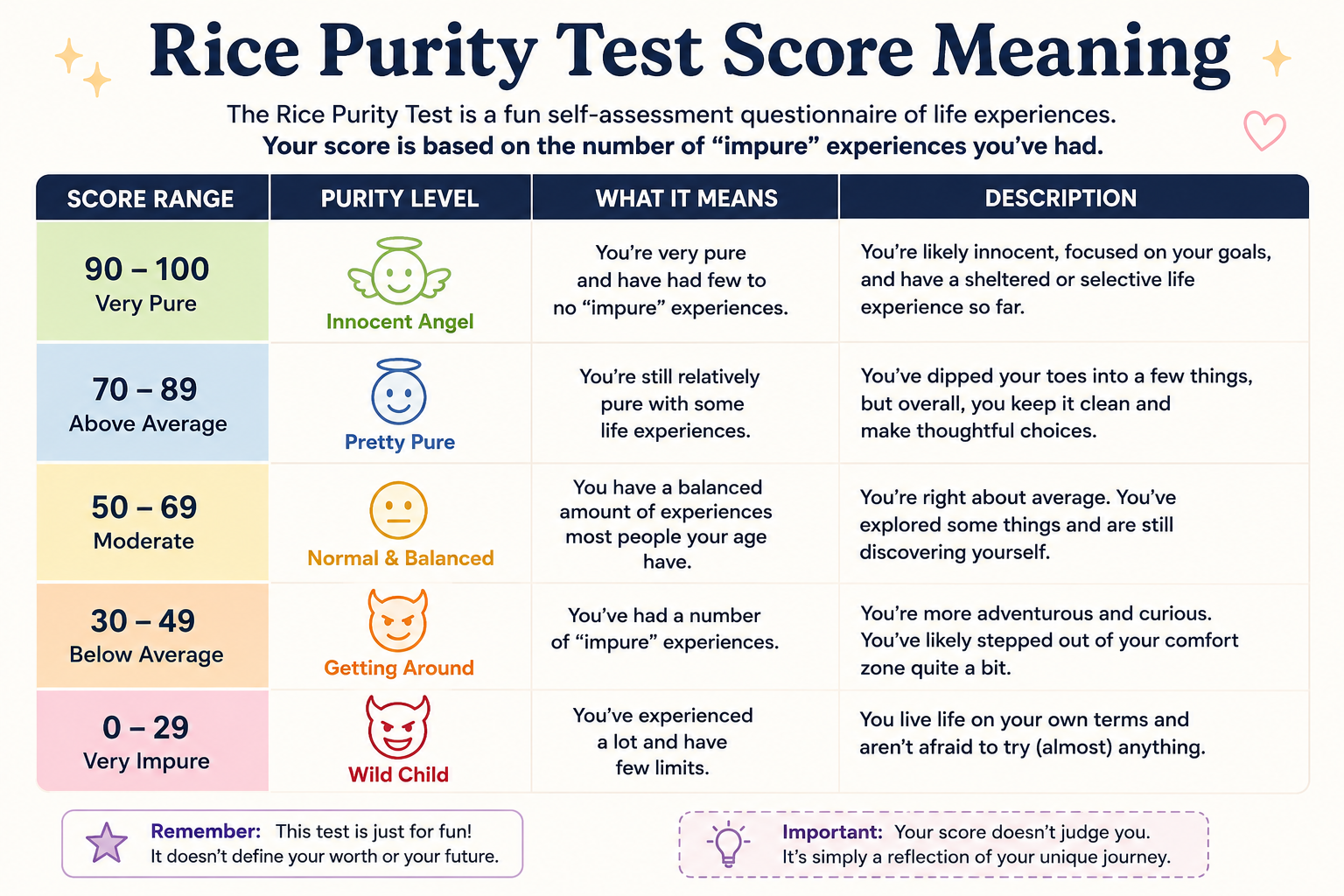
The Rice Purity Test Score Meaning refers to how a person’s score reflects their self-reported life experiences based on a 100-question checklist. Each question covers a different type of experience, ranging from innocent childhood activities to more mature or socially sensitive topics such as relationships, substance use, and rule-breaking behavior. When someone answers “no” to an item, their score remains higher, while a “yes” reduces it, making the final number a reflection of how many listed experiences they claim to have had.
At its core, the Rice Purity Test Score Meaning is not about judging character or morality. Instead, it is a simple numerical representation of personal experiences, often used in a casual or social context. A higher score generally suggests fewer experiences from the list, while a lower score indicates more exposure to them. However, these interpretations are informal and should not be treated as scientific or absolute measures of a person’s life or personality.
Origin of the Rice Purity Test
The Rice Purity Test originally began at Rice University in the United States as a lighthearted activity for students, particularly freshmen, to help them bond and share experiences in a humorous and open way. It was never intended to be a serious evaluation but rather a social icebreaker that encouraged conversation and connection among new students adjusting to college life.
How the Score Is Calculated
The calculation behind the Rice Purity Test Score Meaning is straightforward. The test consists of 100 questions, and each question represents a specific experience. When a participant answers “no,” they retain one point for that question. When they answer “yes,” they lose that point. The final score is simply the total number of “no” responses out of 100.
Because the scoring system is entirely self-reported, it relies on honesty and personal interpretation. There is no external verification, and different individuals may interpret questions differently. This makes the Rice Purity Test Score Meaning more subjective than objective, as two people with similar life experiences may end up with different scores depending on how they respond to each question.
What Different Score Ranges Mean
Different score ranges in the Rice Purity Test Score Meaning are often interpreted informally rather than officially defined. Generally, higher scores (around 90–100) suggest limited exposure to the listed experiences, often associated with younger individuals or those with more conservative lifestyles. Mid-range scores (around 50–89) typically reflect a mix of common life experiences such as dating, social drinking, or minor rule-breaking.
Why People Take the Test Today
Today, people take the Rice Purity Test mostly for entertainment and curiosity. It has become popular on social media platforms where users share their scores and compare them with friends or influencers. The test often sparks conversations, humor, and sometimes surprise, making it a lighthearted way to engage with others online.
For many, the Rice Purity Test Score Meaning is less about the number itself and more about the experience of taking the test. It allows individuals to reflect on their past in a structured way while also participating in a shared internet culture trend. In some cases, it is also used as an icebreaker in group settings or among new acquaintances.
Limitations and Common Misconceptions
One major limitation of the Rice Purity Test is that it is entirely self-reported, meaning its accuracy depends on personal honesty and interpretation. Because of this, the Rice Purity Test Score Meaning cannot be considered a reliable or consistent measure of real-life behavior. People may also interpret questions differently, leading to inconsistent scoring.
Psychological and Social Perspective
From a psychological and social perspective, the Rice Purity Test Score Meaning is more about perception than reality. It reflects how individuals view their own experiences and how they choose to disclose them. Socially, it can influence group dynamics, as people often compare scores and discuss differences in a playful manner.
However, psychologists generally do not consider the test a valid instrument for assessing personality or behavior. It lacks scientific structure and standardization, meaning its results cannot be used for meaningful psychological analysis. Instead, it functions more as a social reflection tool that highlights how people perceive and share their experiences.
Is It an Accurate Measure of “Purity”?
The idea of “purity” in the Rice Purity Test Score Meaning is largely symbolic rather than literal. The test does not define purity in any moral, religious, or scientific sense. Instead, it uses the concept loosely to categorize life experiences in a simplified scoring system.
Conclusion
The Rice Purity Test Score Meaning is best understood as a casual, self-reported reflection of life experiences rather than a serious measurement of personality or morality. Originating as a college tradition, it has evolved into a global online trend used for entertainment and social interaction. While it can be fun and thought-provoking, its results should always be interpreted lightly and not as a true indicator of character.
FAQs
1. What does a high Rice Purity Test score mean?
It generally means fewer listed experiences, but it is not a measure of personality or morality.
2. Is the Rice Purity Test scientifically accurate?
No, it is not a scientific or psychological assessment.
3. Why do people share their scores online?
Mostly for fun, social interaction, and comparison with friends.
4. Can your score change over time?
Yes, as people have new experiences, their responses and scores may change.